It has truly been an honor to serve as the President of the AMI this past year and to be standing here in front of you all.
Sailing the High C’s Toward Success
I was thinking all year about what I could wow you with during my presidential address. What I ended up with is mostly based on personal observations and experience. I found it uncanny how much of what I want to talk about starts with the letter C, so I went with it.
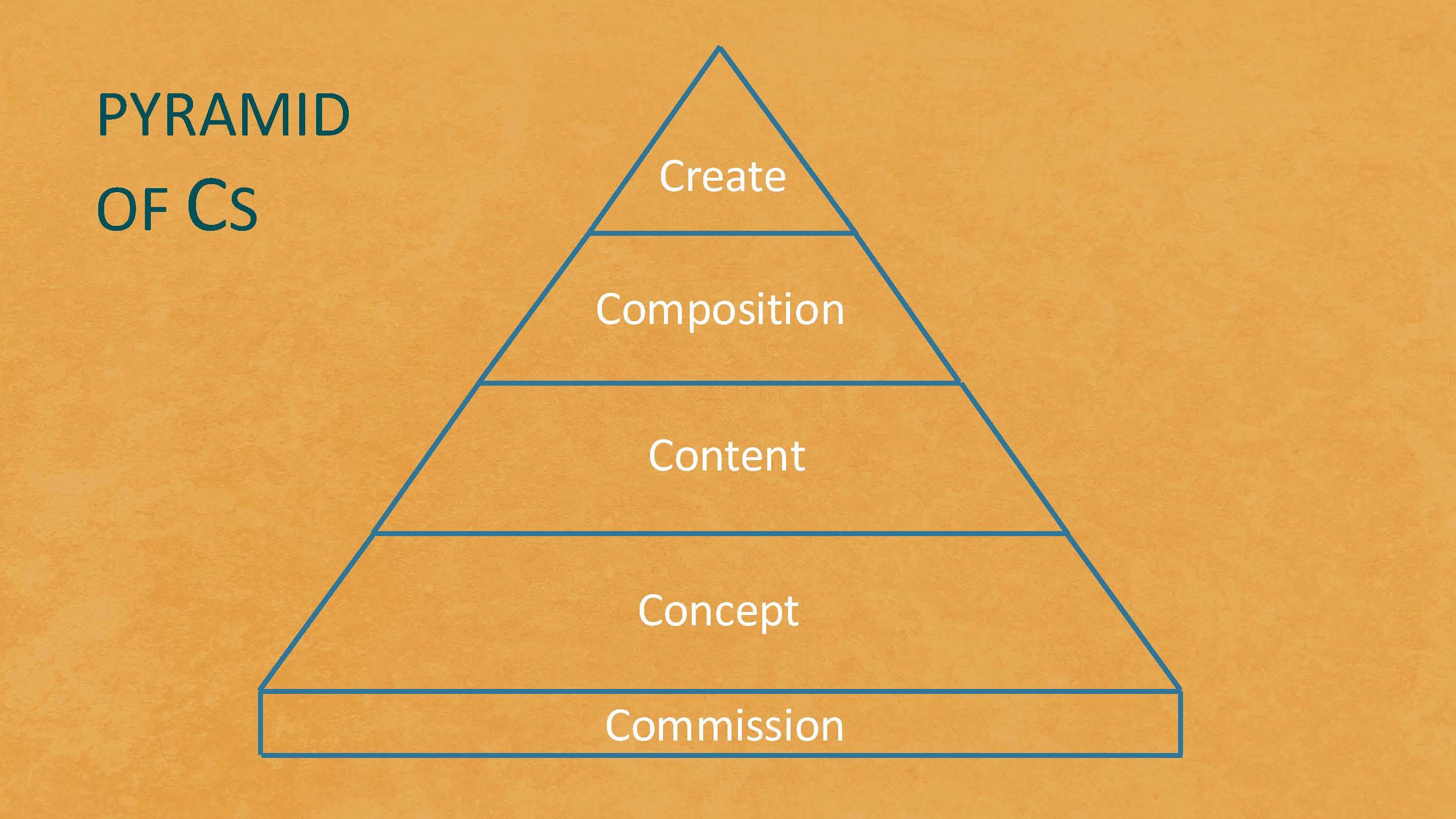
As a professor of illustration at Northern Illinois University School of Art and Design, I needed to develop a teaching philosophy. I thought about how to approach an art project, what steps one can follow to repeatedly raise the odds of a successful outcome. I came up with what I refer to as the Pyramid of C’s. The goal is to build a solid illustration that holds up to scrutiny and has lasting value as a form of visual communication. We start with the base layer – the foundation on which we will build our pyramid. I refer to it as the Commission. We could call it the project or the assignment, but since we hope to make money doing this, let’s call it a commission. A commission is usually the Catalyst to get us started. A commission is just that, a co-mission. You work together with a Client to Communicate an intended message to an intended audience. The visual is going to be created with purpose.
Next comes the main structural support of the illustration, the Concept. It involves researching the subject, reading the manuscript, developing an understanding, and brainstorming an original idea to effectively visually Convey the information in a Captivating way. By the way, this is the value you add to any project – not how well you use a particular software, but your ability to come up with original and Creative ways (avoiding clichés - Cliche) to visually express information. It is to be a Custom Construction. See if you can break the expectation to cause pause.
Next comes Content. These are the objects you use to visually express the concept. It can include literal objects as well as symbolism and metaphor. For example, if I were asked to illustrate the feeling of joy, I might include a humpback whale leaping out of the water. At least that’s one image that pops into my head as a visual representation of joy.
The next piece of the pyramid is Composition. Starting with thumbnail sketches, work out how the Content is placed on the page within the given dimensions and final format. Use visual hierarchy to lead the viewer through the composition, highlighting the primary information while using secondary, tertiary, or supporting information to help balance the design. Consider lighting and shadow, point of view, and what would make it more dynamic or visually appealing. Consider room for labels or any overlying text.
Once these are worked out, you can finally Create the illustration. Add all the beautiful rendering skills you have been practicing. Many artists want to start here because it is usually the fun part. But pretty art without a solid concept and composition is decorative at best. If the pyramids in Egypt were built upside down, do you think they’d still be standing? Many of my students want me to show techniques with various media with the belief that this in and of itself will make them better illustrators. We do learn and practice techniques, but technique is just a small part of a successful illustration and, arguably, it is more important to learn how to think than how to draw. Technique will come with a lot of practice, like learning a musical instrument. The more you create, the more you will increase your Control and Command of media.
 With the supporting layers in place, you can now create the final artwork knowing that the illustration will have value and be worth the time spent making it beautiful in your chosen media.
Now imagine the pyramid is built next to a reflection pool. Let’s reflect on the success of our construction. This is the assessment, or Critique, of what would make it better (WWMIB). We should ask ourselves WWMIB at every stage of construction, but now we can assess how successful we were overall. When we understand what can be improved, our next construction will be even better. When we are students, we have the benefit of classmates and faculty and instructors who can help us identify WWMIB. That is why critique is such an important part of our training. The goal is to get good enough at identifying WWMIB so that once we graduate and are on our own, we can assess and adjust accordingly before sending the work to a client. I credit my professor Dierdre McConathy with hammering my student work to forge it into something that could potentially compete in the professional arena. No matter how successful I thought a project was, she would always tell me WWMIB. And she was always right. IMO, the professors who set the bar frustratingly high are the professors who are helping you succeed the most.
The C’s of Success
Let’s talk about some less tangible aspects that can lead toward success.
Confidence or Courage?
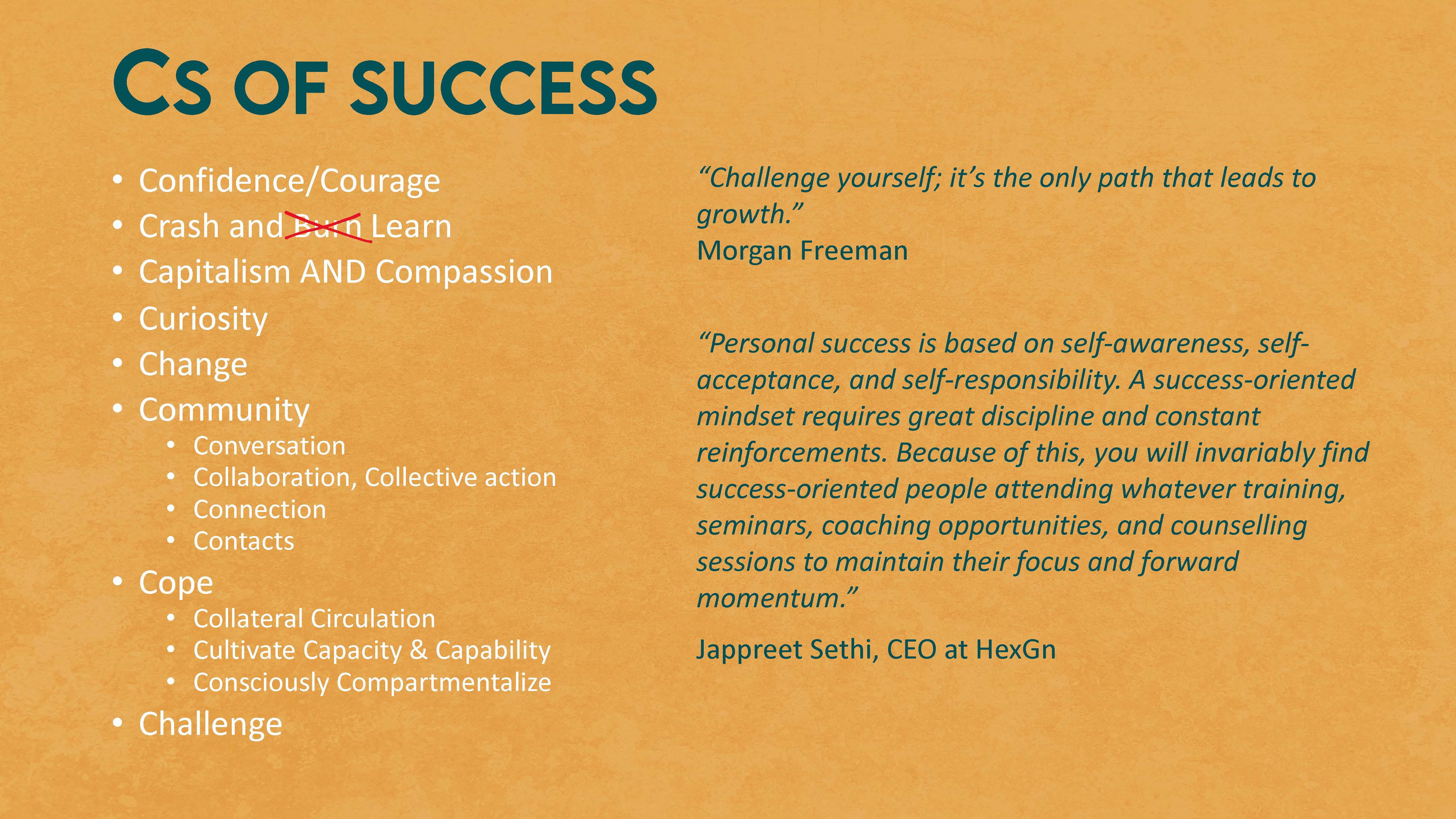
I used to tell my senior students that Confidence is as important to success as a good portfolio. It is not always the most talented artists that get the jobs, it is more likely the ones who are persistent in marketing themselves. It takes confidence to put your work out there again and again, to verbalize your strengths beyond knowing how to use a particular software, to attend conferences or workshops and meet people face-to-face (which can be especially difficult for introverts), to participate in online conversations, to start a blog, to be judged. But then I realized I was using the wrong word. The more accurate word is Courage. Confidence comes with experience and repetition. With all the unbelievable talent our newer young members possess, the only thing they may lack is years of experience. Any one of them, given an opportunity, will fly. Courage is needed to venture into the unknown, boldly knock on doors, and find those opportunities. Be uncomfortable, apply for jobs that you feel may be just out of reach, contact people in the field for informational interviews, ignore the internal conversation that loves to mess with your self-esteem, volunteer to be on a committee, walk up to a complete stranger at a conference and introduce yourself, be persistent and undaunted in working toward your dream. There is ‘The World’ and there is ‘Your World’. You can keep them separate but will need to interact with both.
The most abusive relationship you may ever be in is your own internal conversation telling you that you can’t do something or are not worthy. It may be the only thing holding you back from living your dreams. It takes courage to act despite that internal conversation. When I first started my company, I would listen to a motivational speaker named Les Brown. His positive message telling me I could do it was constantly playing in the background, and it helped drown out doubt.
So you sum up the courage to enter the race. You step up to the line, heart pounding, and say to yourself, “Let’s do this. What’s the worst that can happen?” Likely, you will get swept into the race and find that you do indeed have what it takes to do well. You are keeping pace with the others, and you even find yourself smiling! Ha, you got this! But no one told you about that pothole. Pow!
Crash and Burn Learn: Failing Forward and Happy Accidents.
Did you ever notice the more heinous the failure the better the story? The kind of stories that start with, “Dude, remember that time we almost died?” They become epic tales of bravery, heroism, and overcoming great obstacles. A lot of books would not have been written without great heroism and perseverance in the eye of a storm. Oprah Winfrey would have had nothing to talk about with her guests if they had nothing to overcome. My students seem to like when I tell them stories and anecdotes of when things did not go right. This was a topic at the AAA’s 2024 Anatomy Connected Conference. They had several presentations that talked about when things didn’t go as planned. It would be a great topic for the AMI to consider including in a conference or webinar. Experience has value, as does sharing those experiences. I also think revealing experiences of failing eases a young person’s mind from feeling like they must be perfect to succeed. Or, as Albert Einstein said, “Failure is success in progress.” With enough experience, you can choose a direction with the best chance of success. Thank you, failure, for this data.
Are you “achievement motivated” or are you “failure-avoidance motivated”? Achievement motivated people are not afraid of failing. They will jump in even if it means not being good at it the first few times. They will keep at it undeterred with a goal in mind and quickly gain experience by doing. Failure-avoidance people will stay on the sidelines and only participate if they are guaranteed success. They do not grow and excel as fast because they avoid the risk of looking foolish. “I’ll only do it in front of others when I am perfect at it.” It is not that kind of party, and that day may never come.
One more note about Confidence. In grad school, a visiting artist asked our class what it is we thought we were selling to a client or art director. We all thought literally and said things like, “our creativity” and “duh, illustrations”. He said, “No, you are selling peace of mind.” Peace of mind that you will handle this project perfectly, you will create beautiful imagery, meet the deadline, stay on budget, and make the art director look good. The art director wants to be able to focus on other things, knowing you got this. If you do not act confident and question your own abilities, the art director may not have peace of mind that you were the right choice. More than once I got projects that I confidently said I could handle, then hung up the phone and thought to myself, how in the world am I going to pull this off? In fact, my first major project right out of grad school was to illustrate an atlas of liver surgery for a surgeon at the University of Chicago. It was to be 120 illustrations in 6 months. The publisher asked me point blank, “Can you do 120 illustrations in 6 months?” I confidently replied yes. With the little experience I had up to that point, I wasn’t even sure how long it would take me to do one. It ended up being 160 illustrations in 9 months. Believe in yourself, Commit, figure it out and force yourself to grow.
Capitalism Versus AND Compassion
Sometimes it feels as though capitalism and compassion are at odds, but we are fortunate to have chosen a career path that has altruism baked in, and it feels good to know that what we do helps people. Nick Woolridge did a wonderful job talking about the importance of Compassion and empathy two years ago during his presidential address.
Biomedical visualization is a specialty that requires advanced study and unique skills. What we offer is valuable and each of us works extremely hard to develop the skills necessary to be successful in this profession. Our relentless drive to keep improving and passionately defend whatever we feel upholds the highest standards of our profession is, IMO, because our art and our identity are often united. One obvious measure of success, especially in a capitalistic society, is a financially rewarding career. If this profession did not offer at least the potential for that, there would be far fewer of us in this room. And if that were the case, there would be less medical and scientific visuals being created to improve research and healthcare that has then improved the lives of so many. If it is true that our art and our identity are united, and we are compassionate toward others, it makes sense that we would want to use our art to help others whenever possible.
While I am not an expert on debating the pros and cons of capitalism versus other economic systems and societal structures, is there anything wrong with working toward the benefit of others while also serving our own needs or creating a path toward wealth through service? It seems capitalism affords us the ability and resources to act on our compassion. I’m sure the likes of Noam Chomsky could find fault with this reasoning.
Sometimes we get wonderful opportunities to work on projects that align with causes we feel strongly about. That is when we really feel like what we are doing can make a difference in the world. Does that mean we should be expected to charge less for our expertise? Or, conversely, should we say, “I believe strongly in this cause and am fully capable of helping, but I am only willing to help if I am paid enough.” Compensation can take more forms than a paycheck. There may be projects that not only align with your beliefs and convictions, but they can also be a good business decision. Rewards may include positive PR, global distribution and acknowledgement leading to name recognition and more commissions. It can help give your business and your brand a boost.
But, as my brother smartly told me when I was starting my business, being busy and making a profit are not the same thing. And no one wants to feel taken advantage of. It is often up to us to educate clients of our unique value and negotiate a mutually beneficial arrangement. Illustrators benefit by recognizing themselves as a company, and it is imperative that every company know how much they need to earn to cover expenses and make a profit if they want to stay in business. The best scenario, of course, is to work on meaningful projects AND negotiate professional rates for the work and the rights purchased AND make a profit. However, if you are not a publicly traded company beholden to shareholders, how much profit is a personal choice, and what constitutes compensation and reward varies from artist to artist.
Curiosity
Curiosity drives us forward while adding the delight of discovery. Friends of curiosity are wonder and awe. Wonder contains attributes of surprise and joy combined with our innate desire to understand the world. Awe reminds us we are part of something much grander than ourselves and generates inspiration. Like most of you, I love nature and am inspired and awed by nature. I want to understand that which I proclaim to love. Everything we learn about, from molecules to organisms to entire ecosystems and galaxies, is a piece of a puzzle, each connected and contributing to the whole. There is more to learn and discover than there is time in one lifetime, so the quest feels insatiable. I believe medical illustrators are driven by curiosity, wonder, and awe, and we are never at a loss for more things to study and be inspired by, which makes it an excellent long term career choice. And we pay homage to that which we love by painting loving portraits of what we learn so others, too, can see and understand its beauty. We want to move those who view our art to also be curious and filled with a sense of wonder.
Have you ever asked yourself WHY being a medical illustrator feels so fulfilling? According to Todd Kashdan, psychologist and author of Curious? Discover the Missing Ingredient to a Fulfilling Life, “Humans find intense, lasting fulfillment in seeking new knowledge, new experiences, and in embracing uncertainty.” One thing missing from the Pyramid of C’s I introduced earlier is a sense of uncertainty during the process. For me, at least, it seems to come with every project. Experience tells me to keep going, it will come together. But there is always a point where I’m not sure. Will I be able to solve this puzzle? That sense of uncertainty expands our creativity and, when the illustration is resolved, adds to the feeling of achievement and reward. It is a hit of dopamine and a hit of happiness and satisfaction.
Change
For longevity in this career, or any career for that matter, it is important to stay current and be willing to change to meet the demands of the industry. Evolve to deal with it. That is an important part of what the AMI offers its members through the annual conference, webinars, and the HUB. Whether it is learning new technology, learning about medical and scientific breakthroughs, navigating copyright laws, or getting answers to your questions from a fellow member, the AMI is a Conduit of information to help us stay Current and Competent.
For me personally, changing from an airbrush artist to a 2D digital artist, to finally incorporating 3D modeling has been a fun challenge! ZBrush modeling and rendering software like Keyshot and Substance Painter are like magic to someone like me who started with paint and friskets. And any of you young people who think it is “kinda cute” that the old guy talking right now is proud to have made leaps into media currently being taught in college, you, too, will have to make leaps from what you know now if you plan to do this for over 30 years.
Most of us tend to approach ideas and tactics with a reliance on what has been done before. Once an outlier provides a change in perspective and/or reveals new information, the masses slowly, though often reluctantly, shift their thinking until THAT becomes the new norm. Earth is flat. No, it’s round. Planets and the sun revolve around the earth (a typical human-centric way of seeing the world). No, the planets in our solar system revolve around the sun. Blasphemy! The ones proposing new ideas and perspectives were once persecuted with threat of execution. Being forced to think in new ways can scare people and make them feel threatened.
AI is the new scary change, and it is instinctual to feel threatened. However, I believe industry will adapt, we will adapt, and we will harness its power as another useful tool. Laws, as usual, are trying to catch up to new technology, but they will change, too. I look forward to seeing how the laws will affect our ability to register copyright to new images and protect copyright of existing images. And there are AMI members who are already embracing the change and using AI in ways to increase the level of their imagery and research. And that will eventually become the new norm.
As Frederick Pferdt, founder of Google’s Innovation Lab and author of What’s Next is Now: How to Live Future Ready states, “You can’t avoid what’s next but if you ignore or resist it, then your future will happen to you. By embracing change and making it work for you, you will be more optimistic and see change as an opportunity that opens doors to so many possibilities and possible futures.”
Sometimes, we unknowingly perpetuate ideas that can cause harm. New revelations change how we view ourselves in the world and how we act or react with this new knowledge. “If I knew better, I’d do better.” Being willing to change how we think based on more gathered evidence is how we can correct our course. For example, a historical lack of diversity in medical illustration is a course the AMI has been consciously working to change. And the ship is slowly turning. Consciously thinking about who we welcome into our community, who we represent in our illustrations, and doing our best to promote diversity and inclusivity is becoming the new norm.
When it comes to change, we are not completely helpless. You can get involved in trying to make a change you feel needs to be made. Get on a Committee, become proactive. It is hard to change others’ behavior or to get them to care about something that is important to you personally, or to get others to share your dream. Start with yourself. John Pavlovitz, a North Carolina-based pastor and author of Worth Fighting For: Finding Courage and Compassion When Cruelty is Trending wrote, “We are not passive participants in this life. There are things that are out of our control, but there’s a great deal that we have agency over. It’s about really leaning into those things and building the kind of nation we dream of seeing…It’s about caring for human beings and realizing that we are one interdependent Community and we are tethered together.”
Community
Jill Gregory did a nice job talking about community in her presidential address last year. What is community and why is it important? Community is a group of individuals with common goals and shared purpose that collectively work together. One of the goals of the AMI is to create a positive, inclusive, and supportive community that promotes personal and professional growth of its members.
What constitutes a great community?
- Conversation: two-way communication of ideas and information; listening for the needs of the other people in the community.
- Collaboration and collective action: we are much stronger and can achieve more benefits for community members when working together as a group.
- Connection: have a sense of belonging, create a welcoming environment, remove barriers. One challenge of every community is how to incorporate individuality and differences. Exchange of ideas is a major benefit of a community, but connections are strongest when everyone in the community treats each other with respect and kindness. For me, it is reassuring to be around kindred spirits who not only share my passion for medical illustration, but also inspire me, lead by example, and unselfishly share ideas.
- Contacts! Our members are our biggest resource. The AMI community is made up of diverse members and each has something to contribute. Even though most of the time I work alone in my studio, I don’t feel alone. If I need help with computer hardware or software, there are members I can contact. If I need to hire an animator to collaborate with on a project, there are members I can contact. If you are looking for work, there is no better place to network than among our members who know the industry and know the people in the industry.
I cannot emphasize enough the benefits of being part of the AMI community. Will every member always see eye to eye on everything? Not a chance, and that’s okay. As long as we keep the overall mission of the AMI as our purpose and treat each other with respect and kindness, we’ll do great things together.
Cope (with Change and Stress)
Each of us should have tactics we can rely on to cope with difficult times. Here are a few ideas: we can cope with change through Collateral Circulation. Collateral circulation, developing new or alternate routes to get to our destination, is how we can bypass unexpected roadblocks. Sudden surprises or changes to the norm can be shocking. Covid-19 is a good example of a sudden change to business as usual. We were forced to quickly navigate new routes to achieve results without our usual physical face-to-face interactions. It was initially uncomfortable, but we found many of the new routes became reliable main arteries even after we were back to meeting in person. Remote meetings and workdays have remained viable for many and taken thousands of cars off the roads. Forced changes to the status quo can reveal better routes and efficiencies.
We can also cope with changes by continuing to Cultivate Capability by improving skills and acquiring new knowledge. We don’t want to go through life with a “yes I can” attitude and a “no I can’t” aptitude. This profession requires a passion for lifelong learning.
One way to cope with stress is to spend time Cultivating Capacity (physical, emotional, mental, and spiritual) for our own well-being. The more fully we know and develop ourselves, our relationships to others, and the environment, the more tools we have when faced with challenges.
Another way to cope with stress is to Consciously Compartmentalize. By consciously compartmentalizing stressors, we can be self-loving and give ourselves permission to only focus on what we can handle in the moment. We can create a parking lot for the other stuff. We can let go of stress-inducing factors that are truly out of our control. It is not the same as disconnecting, putting our head in the sand, or complete dissociation. We can be fully aware and informed, but if the only thing you can personally do about it is to stress out, do your best to let it go and focus on the things you can actually work on in the moment. Remember, there is your world, and there is the world. You will need to interact with both, but you can also set boundaries when you need to.
Challenge
 The best way to grow beyond where you are right now is to continually Challenge yourself and set goals, whether they be professional or personal.
The best way to grow beyond where you are right now is to continually challenge yourself and set goals, whether they be professional or personal. I love to set goals and then Commit toward achieving them. It gives me a direction to put my efforts. It makes me feel as though I am driving the bus of my own destiny. Life is what YOU make it. How bad do you want it? Bad enough to step out of your comfort zone? You are in charge of building the life you want. Without challenging yourself to reach goals, where do you go?
You can also Challenge the status quo. That requires astute observation and critical thinking, to see things as they are and imagine a different or better or more just way. Because something was done one way for many years does not mean it is the only way.
Celebrate
 Don’t forget to Celebrate your successes!
Life is a Continuum of Circumstances, Choices, and Consequences. We often hear the phrase, “you will suffer the consequences”. It is easy to focus on negativity and give it more weight. You hardly ever hear someone say, “you will celebrate the consequences of your choices.” Celebrate good choices, celebrate jobs well done, celebrate good relationships, celebrate laughter with friends, when life throws a sucker punch, celebrate another chance to get back up and try again, heck, celebrate a good cup of coffee on a chilly morning. Celebrate being here right now in this supportive learning environment and being even better tomorrow than you already are today.
Thank you.